
Study on Whether the Curved Shape of the Rainbow Originates from the Curvature of
Water Droplet or Simply Represents Solar Disc Edge Refraction
1 ABSTRACT
The most widely accepted explanation among scientists is that rainbow is formed by
the refraction and reflection of sunlight within each individual water droplet.
According to this view, the combined effect of all the refracted and reflected rays from
countless droplets creates a single rainbow visible on the horizon.
However, this explanation appears to raise a contradiction: if each droplet produces
such an effect, the result should be thousands of rainbows (one per droplet), rather
than a single unified arc.
The standard explanation addresses this by proposing that the geometry of the
reflection is such that only those reflected rays on a specific cone—with the observer's
eyes at the vertex—contribute light to the visible rainbow. This cone would define the
circular shape of the rainbow.
Nevertheless, an alternative interpretation could be that the circular rainbow shape
arises from the refraction of Solar disc as it interacts with ambient moisture.
This hypothesis also poses challenges, such as the fact that we do not see the entire
solar disc as iridescent in the sky—only its colored edge appears.
Both explanations deserve careful and detailed analysis, which this study aims to
explore.
1. INTRODUCTION
The aim of this study is to analyze the shortcomings of the currently predominant theory on rainbow formation—based on the
refraction and reflection of light within water droplets—and to propose a simpler alternative: that the rainbow reflects the
diffracted arc of the solar disc.
Alternatively, one might consider that the arc shape of the rainbow results not from the spherical curvature of the droplets, but
from the curvature of the solar disc itself. This hypothesis suggests that the iridescent arc is a consequence of how Sun edge light
diffract during its passage through moisture in the atmosphere.
Both interpretations raise fundamental questions about the origin of the rainbow’s geometry. This paper explores the optical
reasoning behind each approach and aims to clarify which mechanisms most accurately account for the phenomenon.
2 TRADITIONAL THEORY;RAINBOW CURVED SHAPE DEPENDS ON WATER DROPLET CURVATURE
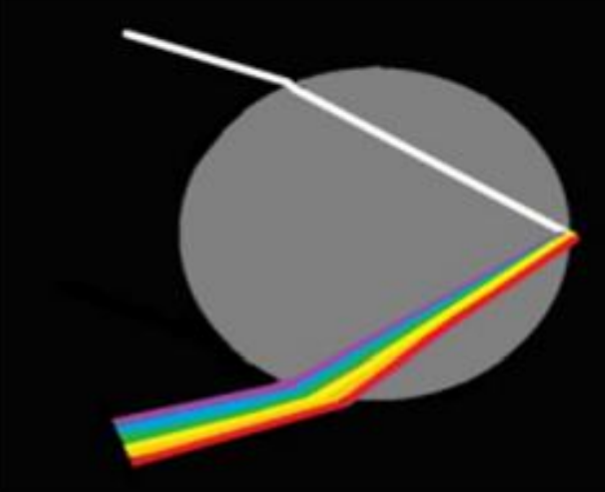
Fig 1: Light reflection in water droplet.
Rainbows are among the most admired and widely studied
atmospheric optical phenomena. Traditionally, it has been
explained as the result of the interaction between sunlight and
countless water droplets suspended in the atmosphere after a
rain shower. The classical model, established through the
works of Descartes and Newton, proposes that the rainbow
emerges from the combined effects of internal reflection and
refraction, of light inside each droplet.
In this model, sunlight enters a spherical droplet, reflects at
the water interface and refracts internally once upon exiting.
The angle at which light emerges from the droplet, produces
a concentrated arc of colored light. When this effect is
multiplied across millions of droplets aligned at a specific
angle relative to the observer, the result is a single, circular
arc: the primary rainbow.
2.1. TRADITIONAL THEORY PROBLEMS
1. If each droplet produces a rainbow through individual
optical processes, why do we observe only one coherent
arc instead of thousands of overlapping rainbows?
2. To resolve this, it is commonly argued that the geometry
of the reflected rays alignment along a specific conical
surface, with the observer’s eye at the apex. This
geometric alignment would then account for the singular
circular appearance of the rainbow. But why light is
reflected along a cone is not well understood and it seems
that too many droplets’ reflections must coincide for this
to occur.
3. For rainbows reflected by thousands of drops to
converge into a single rainbow, a curtain of water drops
aligned on a smooth, uniform surface would be needed,
whereas rain and clouds do not have uniformly aligned
water drops.
4. Rain and clouds don’t keep static droplets instead keep
moving ones, The rainbow should look like many multi-
coloured dots falling, but rainbow keep static shape
instead.
5. It seems that for the system to work, each drop must be
placed in the necessary place to converge its light
refraction into a single rainbow, when the drops have an
uneven distribution.
3. RAINBOW CURVED SHAPE BY SOLAR DISC EDGE REFRACTION
This idea would solve the aforementioned problem of
thousands of rainbows formation. The sun refracts its light as
it passes through clouds or rain in the atmosphere above the
observer, and this refracted light is reflected on the horizon
in the rainbow. The clouds or moisture would act as the
Newton’s prism used to decompose the light, and the rainbow
would be reflected in the air in front of the observer, this air
act as a movie screen or mirror
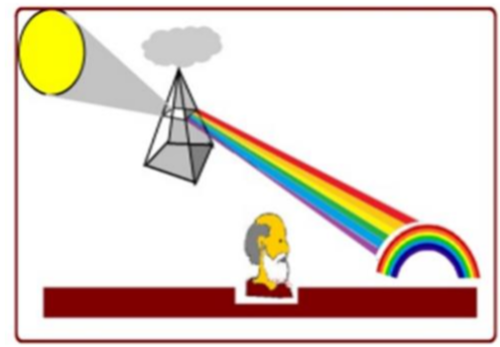
Fig 2: Solar circle refraction to form the rainbow.
Let's analyse the following photo:
Light entering through a section of the door skylight is
reflected by a mirror held by a person; toward the inside of
the same door, this light, while being reflected, is refracted
by the mirror glass. With this experiment, we have replaced
the circular solar focus with an irregularly shaped focus, and
we see that the rainbow formed reproduces the shape of the
irregular focus of door skylight edge. Traditional theory
states that the shape of a rainbow is due to the shape of the
material reflecting the light.
In this experiment, the shape of the rainbow is determined by
the light-emitting source that generates the rainbow.
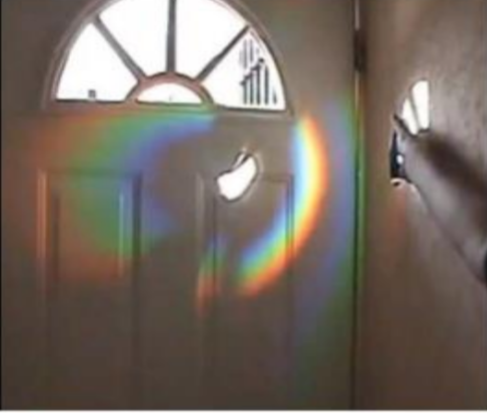
Fig 3: Light reflection on mirror
On next figure light beam shape affects the form of the
rainbow. A parallelepiped-shaped beam of a flashlight
projected on a screen. Rainbow forms along the edges of the
parallelepiped, as a result of refraction of also parallelepiped
shaped light through the flashlight’s glass.
Fig 4: Flashlight with a parallelepiped-shaped focus is reflected.
3.1. PROBLEM OF SOLAR DISC EDGE REFRACTION
The However, considering the origin of the rainbow as
product of solar circle refraction as it crosses the rain raises
some questions:
Obtain a complete iridescent circle as a result, not just an arc.
To solve this problem, we will turn to another classic: Isaac
Newton and his color disc; Newton spun his disk in such a
way that the different colors overlap on our retina, resulting
in a view of the color white. White is the sum of the other
colors. This is what happens in the refracted light from inside
the sun, where overlapping rainbows form, resulting in white
light. The rainbow remains as a remnant at the outline of the
Sun, as overlapping rainbows do not occur at the outline.
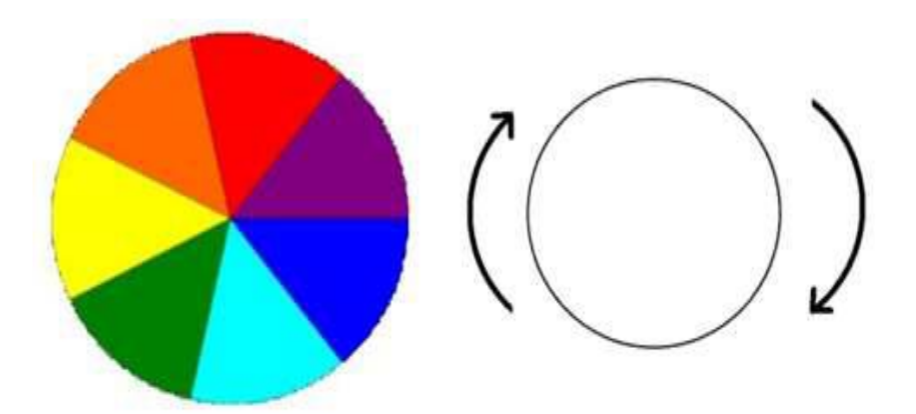
Fig 5: Newtons color disc
Rainbow inside should keep white color, just as Newton's
Color Circle. However, on rainbow inside photos, while not
white, maintain a whitish and lighter tone compared to the
outside.

Fig 6: Rainbow inside in a whitish tone
Why rainbow on the horizon seems much larger than directly
observed sun?
Refraction involves a change in the direction of light. In this
case, the light from the edge of the sun is deflected toward
the outside of the solar circle, enlarging the arc.
4. PROBLEMS THAT TRADITIONAL THEORY CAN'T SOLVE BUT "SOLAR DISK DIFFRACTION THEORY CAN:
Only those reflected rays on a specific cone—with the
observer's eyes at the vertex—contribute light to the visible
rainbow. This cone should place observer at rainbow center.
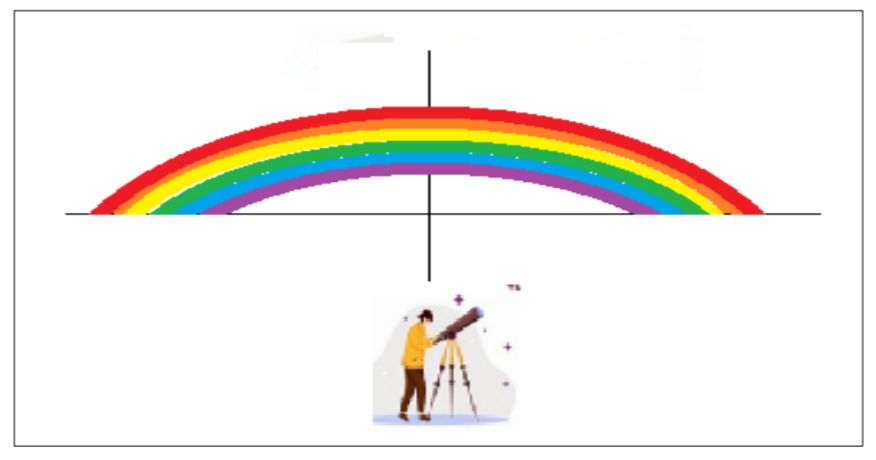
Fig 7: Observer at rainbow center.
in so many photos observer isn't at rainbow center, look at
this rainbow observed from the airplane window.

Fig 8: Rainbow from the airplane window
So, rainbow is reflected in the layer of air that acts like a
movie screen.
5. HOW WOULD SOLAR DISK REFRACTION THEORY EXPLAIN SECONDARY RAINBOEW?
A double refraction could provide an answer
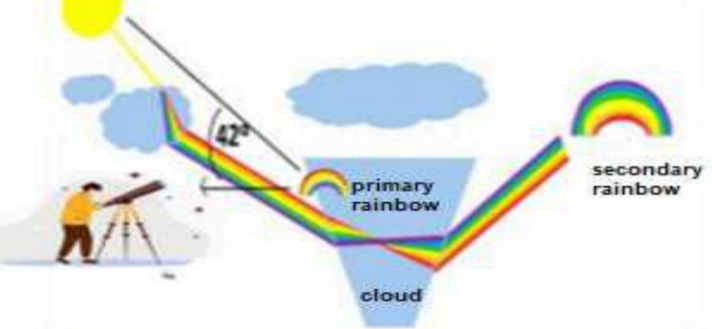
Fig 9: Secondary Rainbow
6. EXPERIMENT WITH WATER DROPS.
In this photo, water droplets are produced by a vaporizer, and
a parallelepiped-shaped flashlight is used as a spotlight. The
light, after passing through the water vapor in the vaporizer
is projected in the wall, reflecting the parallelepiped shape
of the flashlight's spotlight.
The important thing is to see the reflection of the light
produced by the vaporizer's droplets, which, as we can see,
also maintains the same parallelepiped shape as the spotlight.
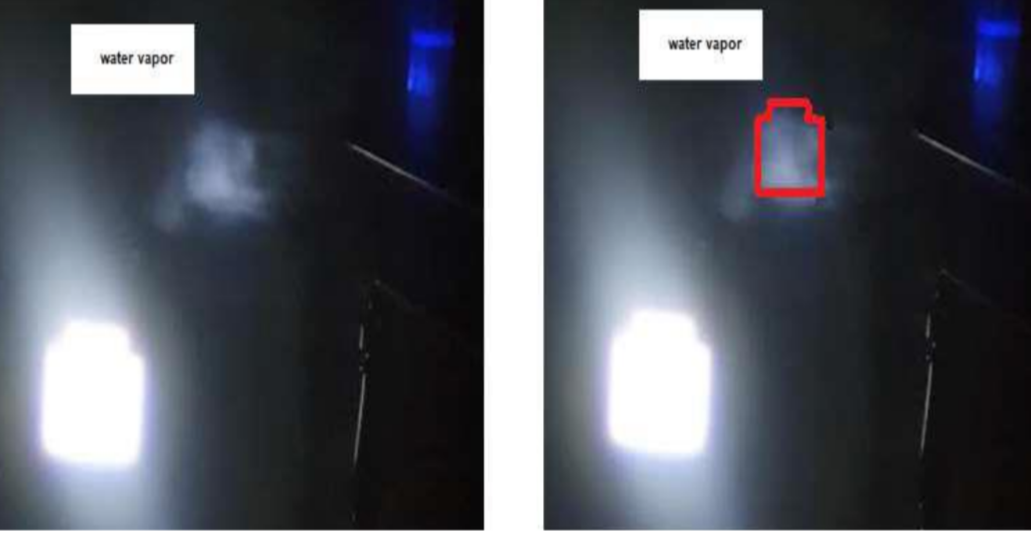
Fig.10. Experiment with water drops.